


.svg)
.svg)


.svg)
∙ 0 min read
What Cardi B’s Fanvue Community Reveals About the Future of Fan Engagement

Author: María José Bianchi
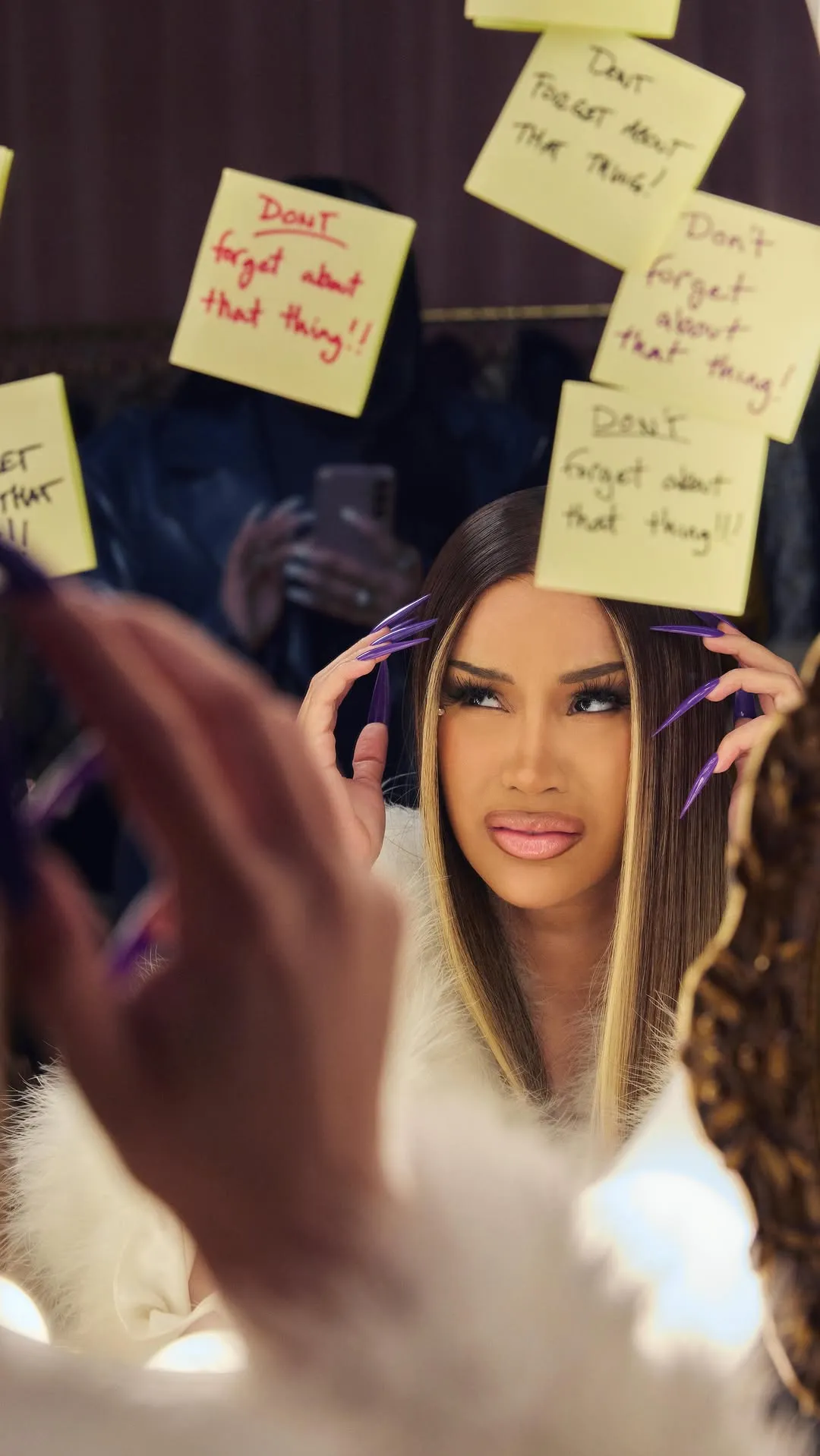
Most promotional campaigns end when the prize is claimed: Fans show up for the offer, and when it's gone, so are they. But what happened when Cardi B launched her official community on Fanvue broke that pattern.
Fresh off a surprise appearance at Bad Bunny's record-breaking Super Bowl halftime show, Cardi announced the launch through a free ticket giveaway for her Little Miss Drama Tour. And fans flooded in with such force that they crashed the platform for several minutes.
But what stood out was that when the giveaway ended, the community didn't fade away. Fans kept showing up, commenting, engaging.
The rapper’s success on Fanvue has lessons for every artist, manager, and talent team. We break down what happened, what it means for the future of fan engagement, and why belonging might be the most underrated force in the creator business.
How the Cardi B Giveaway Became Much More Than a Campaign
Cardi B's Little Miss Drama Tour was never going to be a subtle comeback.
Her first major headlining tour in seven years was backed by Live Nation and featured a 37-song setlist, a stage elaborate enough to suspend her above the audience, and 23 production trucks. Her team had gone beyond preparing for just a tour; they had designed a full-scale cultural moment.
And the Bardi Gang was ready to welcome her. By the halfway mark, she'd already grossed over $32 million and sold nearly 210,000 tickets. The fans were loud and loyal.
But their cheers were coming from everywhere: TikTok, Instagram, X, Reddit, fan forums, comment sections… And because their voices were scattered across multiple platforms, there was no single place where that collective energy could sustain itself.
That's the challenge with social media: these platforms let artists create the passion, but don’t give them the infrastructure to anchor it in a single, unified hub.
This gap is what brought Cardi’s team to Fanvue. Unlike social platforms built around broadcasting and discovery, Fanvue is designed for direct fan connection. It gives fans a single destination to return to, keeping interactions in one place instead of splitting them across platforms.
Cardi built her official fan community around the tour and kept it free. Fans could join, enter weekly ticket giveaways for multiple tour locations, and access exclusive content directly from Cardi's page, all without running into paywalls.
The way Fanvue works made it a unique experience for fans. There are no ads distracting them from their favorite artist, no algorithm deciding whether they even get to see her content, no posts from other creators pulling away their attention.
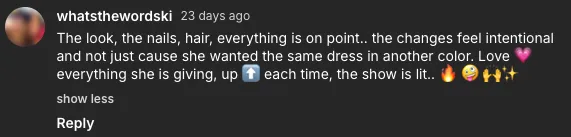
And this gave them the space they needed to bring out their enthusiasm. Inside Cardi B's Fanvue community, fans dissected what the singer wore and planned their own outfits.

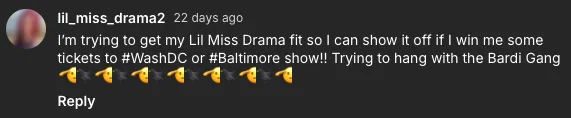
They talked about traveling to another country just to see her in person.

And they committed to engaging on other platforms because of the campaign on Fanvue.
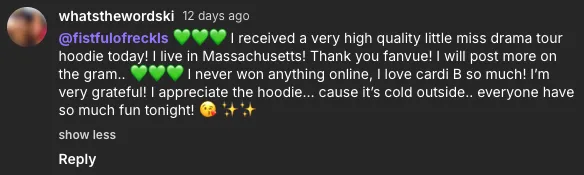
So fans who had joined to win tickets kept coming back even when there was nothing to win. Passive followers became active participants who shared stories, reacted to every tour update, and built relationships with each other.
This behavior pattern is something Cardi B's team understood from the start. The giveaway was only the entry point that would give fans a reason to show up. Once they were in, it was the feeling of community that would keep them there.
Music and the Science of Belonging
Belonging is one of the oldest human drives.
Humans were gathering for shared experiences long before social media, long before concerts, because it was how they made sense of the world and their place in it.
Psychologists call it the need for affiliation. Anthropologists trace it to the tribal structures that kept early humans alive. So we are, at our core, social creatures who need to find our people.
Music accelerates that process in a way few things can. It instantly creates a common reference point with strangers: You feel the same thing, in the same way, as people you didn’t even know existed.
Songs made purely for entertainment give strangers a reason to sing along together. Songs that go beyond entertainment often articulate something the listener couldn’t quite say themselves. And in both cases, it turns individual reactions into a collective force.
You can feel this energy at a live show: thousands of people mouthing the same words, hands up at the same moment. For a few hours, everyone in that space becomes one unit moving in sync.
Fan communities extend this feeling beyond one performance, one night. They give fans somewhere to bring their energy when the show is over.
The Case for Building a Space of Your Own
One of the biggest artists in the world choosing a direct-to-fan platform sends a clear message: that the creator economy is being reshaped. The biggest names are moving toward models built on ownership.
Cardi B's Little Miss Drama Tour was already a phenomenon before her Fanvue community went live, but what her team built around it offers a blueprint that has less to do with her being one of the biggest rappers and more with understanding how to keep fans coming back for more.
Being a music fan is personal in a way that’s hard to explain to someone who’s never been one. Most fans never see their favorite artist live, yet somehow, their songs become woven into their own life story.
This is why music fans travel across countries for just one show, save up for months to be in the front row, and cry after the last song on the setlist. And they want to find the people who share that emotional high.
That's where most artists are leaving untapped value on the table: They don’t channel their fans’ desire to connect.
Building a dedicated space to bring fans together can create momentum you can build on. Fans who feel genuinely connected go beyond simply streaming music. They show up to shows and stay through lineup changes and hiatuses. They're the first to grab early access drops, bundle deals, and limited releases, and they tell others to do the same.
This is because they feel like a part of a community. And it’s community that separates artists with fans from artists with movements that make history.
Take the Beatles, for example. They motivated an entire generation of people to get matching haircuts. Or Taylor Swift, whose fans made themed bracelets and traded them with complete strangers at her Eras Tour.
Scattered energy is lost energy
When you're genuinely excited about something, the first thing you want to do is share that excitement, but if the only place to do that is social feeds built around broadcasting rather than conversation, the excitement dissipates.
The Bardi Gang existed long before Fanvue. They were passionate, vocal, and everywhere, but everywhere also means nowhere in particular.
A conversation that starts on X doesn’t carry over to Instagram. A fan who effuses love for an artist on a Reddit thread never connects with another fan saying the same thing on TikTok.
The excitement leaks in every direction, and in doing so, it loses the power it could have had if it had somewhere to concentrate.
Bringing that audience into one owned space changes everything: the same fans, the same passion, now in the same room.
Socials are great for discovery, not relationships
The ticket giveaway had a start date and an end date, but fans who joined for the giveaway stayed because the space gave them somewhere to keep the experience alive even afterward. This is the long-term value that fan hubs create and that social media platforms can't replicate.
Social media is extraordinary at certain things. It's where an unknown artist can go from zero to a million followers overnight. For discovery, there's nothing better.
But discovery and community are two different things, and the same qualities that make social media so powerful for one make it almost irrelevant for the other.
Social feeds are engineered for distraction. Every scroll brings something new: a meme, a breaking news story, an ad. The experience is designed to pull users in 17 directions at once, because that's what keeps them on the platform.
But when the fan who just had a profound moment listening to your music is watching something completely unrelated 30 seconds later, they never get to a point where they feel connected with you.
A dedicated fan space works differently. When fans enter a community built around an artist they love, everything in that space is pointing in the same direction. There's no competition for attention, and that focused environment is what allows connection to compound.
The energy that would have dissipated across a dozen platforms stays in one place and builds into something that outlasts any single tour or viral buzz.
Either you own the relationship, or the algorithm does
On Instagram, TikTok, and X, the relationship between an artist and their fans is mediated by an algorithm that decides who sees what and when.
The platform owns the infrastructure, the data, and the distribution. This means you’re building a business that’s inherently unpredictable. You don’t know how many fans will actually see your next post, or how quickly it will get deprioritized in the feed.
Essentially, you’re a tenant who’s building something valuable on infrastructure you don't own.
A dedicated fan hub flips around that dynamic. The relationship is direct, with no middlemen and no algorithm standing between the artist and the people who care most about their work.
That means when the next campaign launches, the next album drops, or the next tour goes on sale, there's already a space full of the most engaged fans in the world, ready to receive it.
Fan Engagement Is Moving Toward Something More Focused
What Cardi B's team built is something many artists haven’t quite managed: a single, focused, intentional space where the most passionate fans can find each other, feed off the community’s excitement, and feel like they’re part of something bigger.
The biggest takeaways from the Cardi giveaway are simple
Whether you're an established artist or just starting to build your fanbase, the underlying dynamics stay the same.
A shared moment is the best entry point. The Little Miss Drama Tour gave fans a concrete reason to show up. Moments like these create a trigger for continuing participation.
The value of the space is what converts a one-time visitor into a regular. In Cardi’s case, the giveaway drove the initial surge, but fans stayed long after the prizes were claimed.
The volume-first model was never designed for connection
The new creator model isn’t built on a new trick, but on something a lot older than social media: our natural instinct to find our tribe. And the future of content creation isn't about continuously attracting new fans, but about going deeper with the right ones.
Creators who understand this are building movements that compound over time, that show up between albums and between tours, that don't need a new piece of content to keep the connection alive.
And with Fanvue by your side, that's easier to do than ever.

.svg)

.svg)
.svg)
.svg)
.svg)
.svg)
.svg)
.svg)